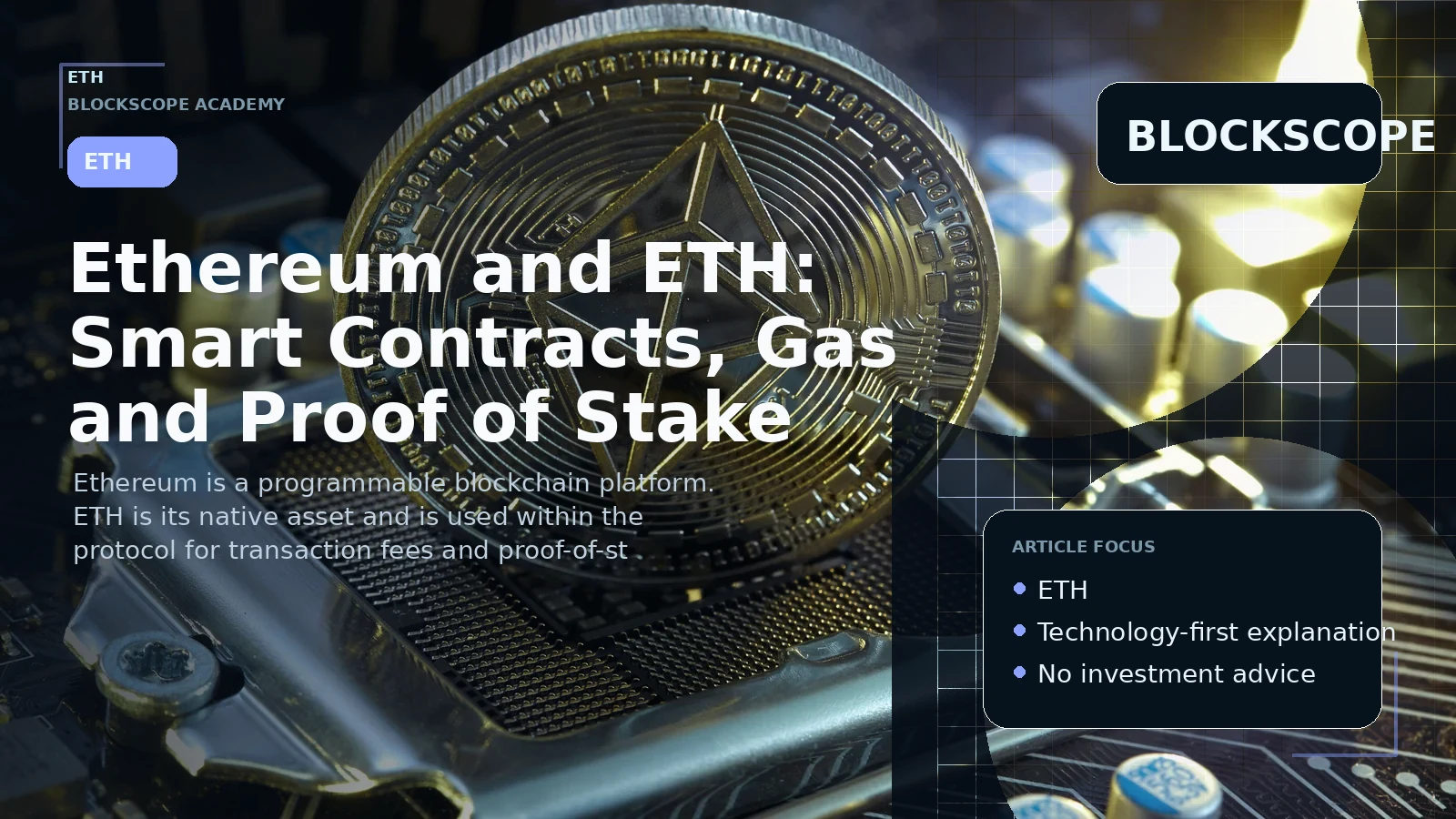
Ethereum is a programmable blockchain platform. ETH is its native asset and is used within the protocol for transaction fees and proof-of-stake validator economics. Ethereum's design supports general-purpose smart contracts in addition to simple transfers.
What you'll understand
- Ethereum nodes execute a shared state machine.
- Ethereum measures computational work using gas.
- Ethereum uses proof of stake.
- ETH is native to Ethereum.
Ethereum as a programmable network
Ethereum nodes execute a shared state machine. Instead of recording only asset transfers, the network can execute smart-contract code that changes application state according to predefined rules.
This flexibility enables token systems, digital identity experiments, decentralized applications and many other designs, while also creating additional complexity and software risk.
Gas and transaction execution
Ethereum measures computational work using gas. Users specify transaction parameters, and the protocol uses gas accounting to prevent programs from consuming unlimited network resources.
Gas fees vary according to network conditions and transaction complexity. This publication does not provide live fee forecasts or trading-oriented analysis.
Proof of stake and validators
Ethereum uses proof of stake. Validators participate in proposing and attesting to blocks under protocol rules. The system includes rewards for correct participation and penalties for certain failures or malicious behavior.
Staking is therefore a consensus mechanism as well as an economic design. It should not be reduced to a simple promise of financial return.
ETH and tokens such as USDT
ETH is native to Ethereum. By contrast, many assets are implemented as smart-contract tokens. USDT, for example, has versions on multiple networks, including networks other than Ethereum.
Users researching tokens should distinguish the issuer, the token contract, the network used for transfer and the custody arrangement.
The clearest way to understand this topic is to separate the protocol, the digital asset, the software interface and any third-party service. Each layer has different responsibilities, dependencies and risks.