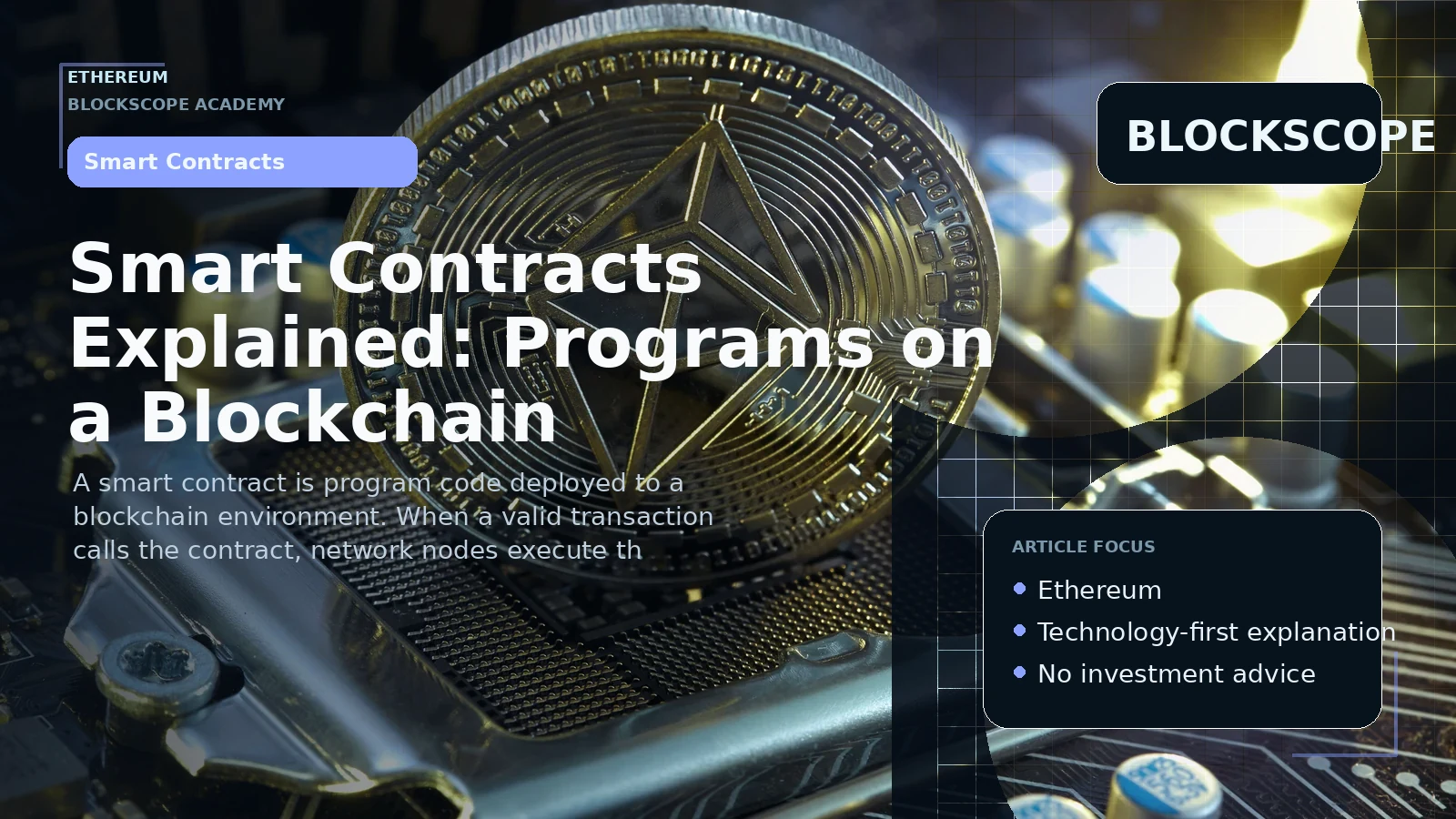
A smart contract is program code deployed to a blockchain environment. When a valid transaction calls the contract, network nodes execute the same logic and agree on the resulting state.
What you'll understand
- Blockchain smart contracts are designed so that network participants can reproduce the same result from the same input and state.
- Many Ethereum-based tokens are implemented using smart-contract standards.
- Some deployed contracts are difficult to modify, while others use upgradeable designs.
- Coding errors, unexpected interactions and oracle failures can lead to losses or unintended behavior.
Deterministic execution
Blockchain smart contracts are designed so that network participants can reproduce the same result from the same input and state. Determinism is essential for distributed consensus.
External information generally enters through defined mechanisms such as user transactions or oracle systems.
Tokens and applications
Many Ethereum-based tokens are implemented using smart-contract standards. Applications can also use contracts for coordination, identity, collectibles and other functions.
A smart contract can automate rules, but automation does not prove that the rules are economically safe or legally enforceable.
Immutability and upgrades
Some deployed contracts are difficult to modify, while others use upgradeable designs. Upgradeability can make bug fixes possible but may introduce administrative trust.
Readers should examine who can change a contract and under what conditions.
Smart-contract risk
Coding errors, unexpected interactions and oracle failures can lead to losses or unintended behavior. Public code review and audits can reduce risk but do not guarantee safety.
The clearest way to understand this topic is to separate the protocol, the digital asset, the software interface and any third-party service. Each layer has different responsibilities, dependencies and risks.